

Is payroll hindering your organization growth?

For management teams, payroll is far more than simply issuing salaries. It involves accurate handling of salary calculations, deductions, tax regulations, and compliance, all while ensuring employees are paid on time every month. When managed manually, payroll can become time-consuming, prone to errors, and administratively burdensome, increasing the risk of compliance issues.

Inefficient payroll processes not only affect employee morale but can also reduce organisational productivity and impact a company’s professional reputation. To overcome these challenges, many organisations are adopting payroll automation. Automated payroll systems reduce calculation errors, ensure regulatory compliance, provide detailed financial insights, and, most importantly, enable management to deliver timely, accurate salary payments while focusing on strategic business priorities.

What is Payroll Management?

Payroll management is the systematic process of administering an organisation’s employee compensation. It encompasses calculating earnings, withholding taxes and deductions, processing net payments, and ensuring legal compliance.

There are several core functions of payroll management, including:
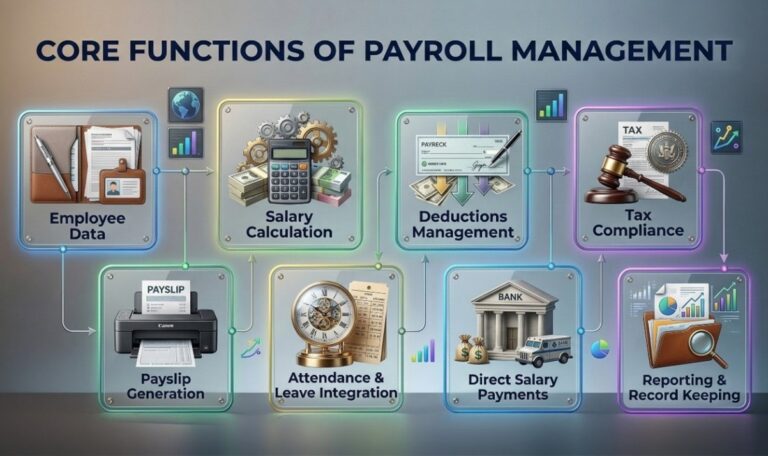
  • Employee Data Management: Maintain and update all employee records efficiently.
  • Salary Calculation: Automate accurate computation of wages, allowances, and overtime.
  • Deductions Management: Handle statutory and voluntary deductions seamlessly.
  • Tax Compliance: Ensure correct TDS, Professional Tax, and other tax deductions.
  • Payslip Generation – Generate detailed digital payslips for employees.
  • Attendance & Leave Integration: Factor in leaves, absences, and overtime in payroll.
  • Direct Salary Payments: Enable secure and timely salary transfers to employees.
  • Reporting & Record Keeping: Maintain comprehensive payroll reports for audits and management.          

Major Benefits of Outsourced Payroll Services

Outsourcing payroll can help organisations overcome these challenges:

  1. Significant Time Savings: Automates tasks like salary calculations and tax filing, allowing HR teams to focus on strategic initiatives.
  2. Cost Reduction & Predictable Expenses: Reduces overheads related to software, hardware, training, and dedicated in-house payroll staff.
  3. Improved Accuracy & Compliance: Professional providers ensure accurate calculations and adherence to labour laws, tax regulations (TDS, PF, ESI), and statutory requirements.
  4. Enhanced Data Security & Confidentiality: Reputable providers use encrypted systems and robust security protocols, safeguarding sensitive employee information.
  5. Access to Technology & Expertise:  Advanced payroll software, employee self-service portals, and expert guidance simplify complex or multi-location payroll needs.
  6. Scalability: Payroll services can easily manage an increasing number of employees without requiring additional in-house infrastructure.

Effects of Inefficient Payroll Management

Poor payroll management can create significant operational and employee-related risks:

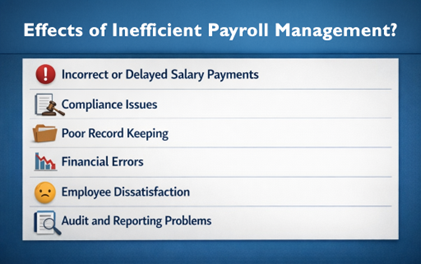
  • Incorrect or Delayed Salary Payments: Miscalculations or late processing affect employee trust, morale, and may lead to labour disputes.
  • Compliance Issues: Failure to adhere to TDS, PF, ESI, Professional Tax, minimum wage, and bonus regulations can trigger penalties and audits.
  • Poor Record Keeping: Inaccurate payroll records complicate audits, tax filings, and employee queries.
  • Financial Errors: Mistakes in salary computation, reimbursements, or bonuses can disrupt cash flow and affect financial integrity.
  • Employee Dissatisfaction: Errors, delays, and unclear deductions reduce engagement and may increase attrition.
  • Audit and Reporting Problems: Poorly organised payroll data prolongs reporting cycles and limits informed decision-making.

Legal Framework for Payroll Management

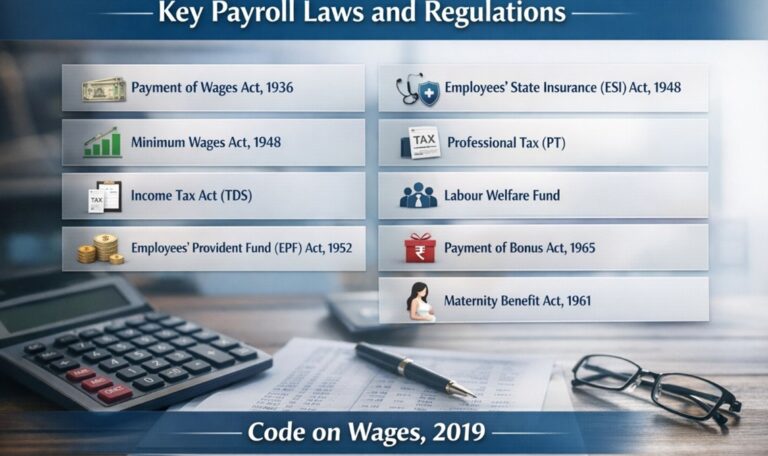
Payroll compliance requires adherence to statutory laws such as the Payment of Wages Act, 1936, Minimum Wages Act, 1948, Income Tax Act (TDS), Employees’ Provident Fund (EPF) Act, Employees’ State Insurance (ESI) Act, and state-specific Professional Tax laws. Organisations must maintain payroll records, complete mandatory registrations, and file returns on time to avoid penalties.

Key Payroll Laws and Regulations:

  • Payment of Wages Act, 1936: Timely salary payments and limits on unauthorised deductions.
  • Minimum Wages Act, 1948:  Minimum wage guarantees and overtime pay at double the normal rate.
  • Income Tax Act, 1961 (TDS):  Mandatory tax deduction at source based on salary slabs.
  • Employees’ Provident Fund Act, 1952 (EPF):  Employer and employee contributions (12% each) for organisations with 20+ employees.
  • Employees’ State Insurance Act, 1948 (ESI):  Medical and social security benefits (3.25% employer, 0.75% employee contribution).
  • Professional Tax (PT): State-level salary tax, varying by region.
  • Labour Welfare Fund (LWF): Statutory employee welfare contributions in certain states.
  • Payment of Bonus Act, 1965: Bonus entitlement based on company profits.
  • Maternity Benefit Act, 1961: Paid leave and job protection for women employees.
  • Code on Wages, 2019: Modernises wage definitions and strengthens compliance.
Overview of Payroll Automation Technology

Automated payroll management leverages advanced software and AI-driven systems to manage employee compensation, tax deductions, and compliance reporting with minimal manual effort. It streamlines processes from attendance tracking to salary disbursement, reducing errors, improving accuracy, ensuring compliance, and saving time.


How It Works:

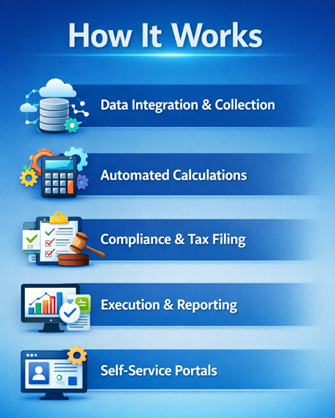
  • Data Integration & Collection: Consolidates information from HR systems, attendance tools, and time-tracking software for accurate payroll processing.
  • Automated Calculations: Computes salaries, allowances, overtime, deductions, and statutory contributions automatically.
  • Compliance & Tax Filing: Ensures adherence to labour laws and tax regulations; automates filings and returns.
  • Execution & Reporting: Streamlines salary disbursement, generates payslips, and maintains accurate records for audits and management.
  • Self-Service Portals: Provide employees access to payslips, leave balances, and tax documents, reducing HR queries and improving transparency.

Why Payroll Automation Matters

Payroll automation reduces human errors, ensures legal compliance, and improves operational efficiency. It streamlines repetitive tasks such as tax calculations, payslip generation, and direct deposits, significantly lowering administrative workload. Automated payroll systems significantly improve accuracy by handling calculations of salaries, taxes, and deductions with minimal errors. They ensure compliance by automatically updating in line with changing labour laws and tax regulations, reducing the risk of legal issues.

These systems also save time and costs for HR teams, allowing them to focus on strategic tasks rather than manual processing. Enhanced security and data privacy are provided through advanced encryption methods, protecting sensitive employee information. Additionally, automated payroll solutions are highly scalable, capable of supporting organisational growth and efficiently managing complex payroll structures. Employees also benefit from an improved experience through self-service portals, which offer easy access to payslips, tax documents, and other essential payroll information.

Conclusion

At the heart of every successful organisation is a reliable payroll system that ensures accurate and timely employee payments. Manual payroll processes are time-consuming, error-prone, and complex. Payroll management systems streamline salary calculations, tax deductions, statutory compliance, and reporting while enhancing transparency, accuracy, and employee trust.

An efficient payroll system forms the backbone of financial transparency, employee satisfaction, and organisational stability, empowering management to focus on strategic priorities while keeping the workforce motivated and compliant.

FAQs

What is payroll management automation in software?

It refers to integrated payroll systems that automatically process compensation, tax deductions, and statutory compliance. These systems connect with HRIS and attendance platforms to improve accuracy, ensure compliance, and reduce manual effort.

What happens without payroll management?

Organisations may face delayed or incorrect salary payments, non-compliance with taxes and statutory contributions, poor record-keeping, financial errors, audit difficulties, and reduced productivity.

How does payroll automation help companies?

It optimises workflows, reduces human error, improves security, and enables data-driven decision-making. Modern technology enhances efficiency, employee satisfaction, and supports digital transformation for sustainable growth.

What should management do to improve payroll management?

Adopt integrated payroll systems, provide self-service portals, automate calculations and compliance updates, and link payroll with HR platforms for accurate, timely, and transparent salary management.

Leave a Reply

Your email address will not be published. Required fields are marked *